

ESG ratings: how they became the language of capital markets
MARKET MATURITY IN LIGHT OF THE ARTHA ESG RATING MONITOR 2026
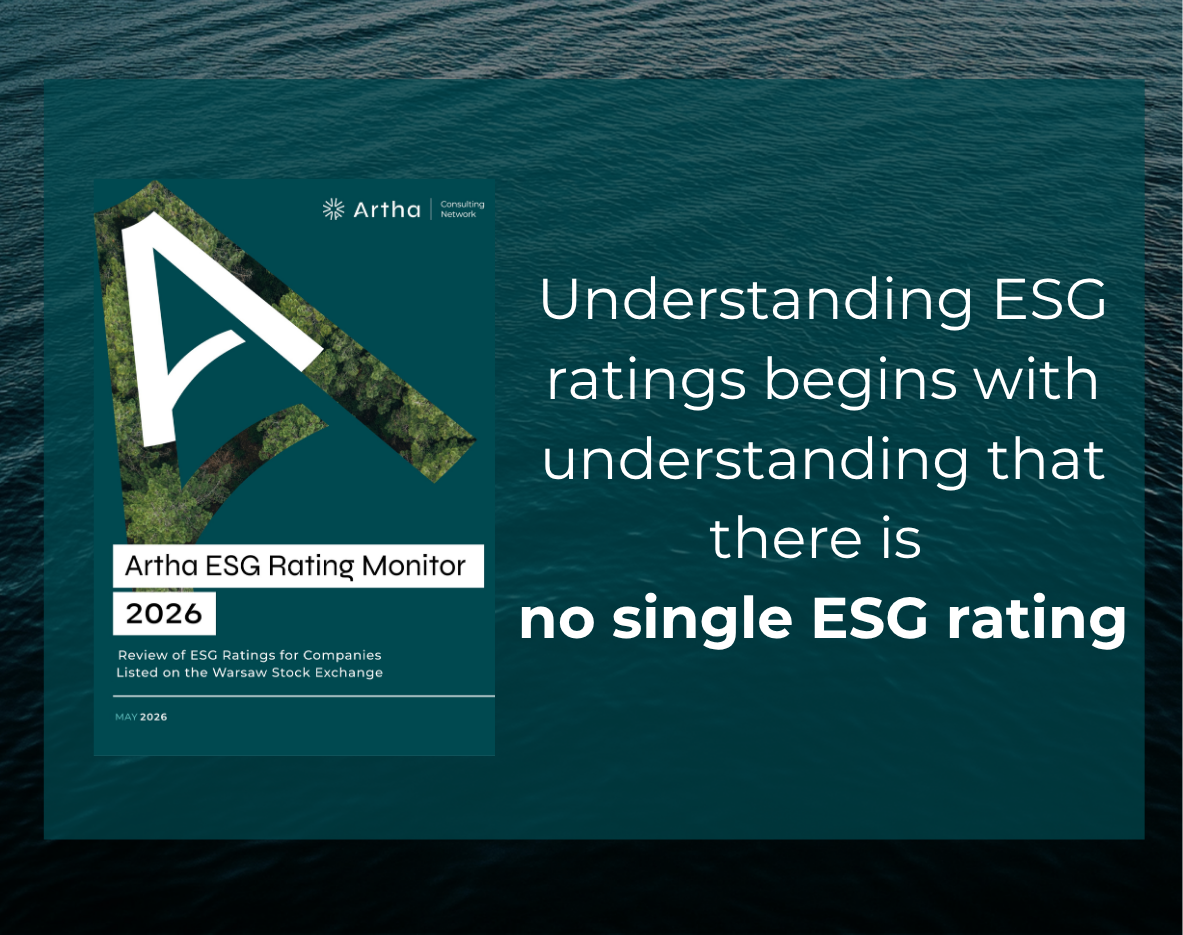
Over the past decade, ESG ratings have moved from a marketing tool to a core piece of capital – market infrastructure. They shape company visibility in investor screens, influence the cost of capital, and provide a common language for the quality of risk management. Artha ESG Rating Monitor 2026 shows where the Polish market stands in that transition – and what conclusions the boards of WSE–listed issuers should draw from it.
What ESG ratings actually are
An ESG rating is an external, independent assessment of how well a company manages environmental (E), social (S) and governance (G) factors. It differs from a credit rating in two important ways. First, it does not measure the ability to repay debt – it measures resilience of the business model to long–term, non–financial risks. Second, there is no single standardised scale. Each agency – MSCI, S&P Global, Sustainalytics, EcoVadis, CDP – applies its own methodology, weights and materiality framework.
This is why the same company can hold an outstanding MSCI AAA rating and a noticeably lower score from another provider at the same time. That divergence is not a market failure – it reflects the fact that different ratings answer different questions. As Katarzyna Szwarc of MSCI Inc. puts it:
„Divergence between ESG ratings is not a sign of market failure. It results from different methodologies and different objectives. Different ratings simply measure different aspects of ESG.”
– Katarzyna Szwarc, Vice President Government Affairs, MSCI Inc.
Why ESG ratings are gaining weight
Three forces are driving the rising importance of ESG ratings. First, regulation – CSRD, ESRS, SFDR and the forthcoming ESG Ratings Regulation are institutionalising the requirement of comparable, auditable sustainability data. Second, investor expectations – financial institutions increasingly build portfolios and due-diligence processes around rating signals, treating them as a proxy for risk–management quality. Third – and perhaps most powerfully in the Polish context – the supply chain.
International buyers verify their suppliers via tools like EcoVadis, while due diligence regulations (CSDDD, the German LkSG, the French Devoir de Vigilance) cascade those expectations down to every company that wants to be a supplier to large international groups. This changes the logic of the game: an ESG rating is no longer a feature of large, listed companies – it is becoming a precondition for market access.
„Legal requirements for supply chain due diligence are rising. For Polish companies, this is an opportunity: if they invest time and resources in strengthening their ESG management systems, they can compete with foreign rivals even when those rivals offer a lower price.”
– Marek Szolc, Ethics & Sustainable Procurement Methodology Lead, EcoVadis
What ESG ratings mean in practice: capital, risk, reputation
For a listed–company board, an ESG rating operates on three levels simultaneously.
1. Access to capital and cost of financing
A growing number of funds operate with negative screening rules or minimum ESG thresholds. No rating – or a low one – narrows the universe of potential investors and limits access to financing on competitive terms. Companies with stronger ESG scores already see this translate into tighter spreads on sustainability–linked loans.
2. Risk management
An ESG rating works as a diagnostic tool. It surfaces gaps in policies, procedures, disclosures, and oversight. Read properly – together with the methodology rationale – it becomes a roadmap of priorities for compliance, risk and ESG teams.
3. Reputation and competitive positioning
In B2B relationships, with international partners and with the media, an ESG rating functions as a condensed, verifiable proof of management quality. It is the reference point in conversations where reading a full sustainability report is not realistic – which is most commercial conversations.
The Polish market in 2026: leaders and the invisible
An analysis of WIG20, mWIG40 and sWIG80 companies reveals a two–speed market. On one side, Poland has companies holding top–tier ratings in international systems – including an MSCI AAA rating and EcoVadis Platinum medals. These are leaders capable of competing with the largest European issuers not only on size, but on the quality of their sustainability management.
On the other side, 41% of WSE–listed companies hold no rating at all from any of the systems analysed. For those organisations, this „invisibility” in the global rating ecosystem translates into reduced exposure to foreign institutional investors, who often filter out companies without a rating signal before any deeper fundamental analysis.
Importantly, high ESG scores are not exclusive to the largest issuers. In the sWIG80 index, 19% of companies hold an EcoVadis rating – proportionally more than in the mWIG40. This is the supply-chain effect: smaller companies often serve as suppliers to international groups and must meet their expectations regardless of their own scale.
Common misconceptions
Myth 1: „An ESG rating is an ethical judgement”
An ESG rating does not assess whether a company is „good” or „responsible”. It measures the quality of risk–management systems, policies, procedures, data and oversight in material areas. It is closer to a process audit than to an ethical review.
Myth 2: „One rating is enough”
Different ratings serve different stakeholders. An institutional investor reads MSCI or Sustainalytics. A corporate buyer reads EcoVadis. A regulator and climate analyst look at CDP. An effective rating strategy means a deliberate choice of those assessments most critical for the company’s key stakeholders.
Myth 3: „The rating reflects what we actually do”
A rating reflects what a company can prove – through publicly available data, policies and disclosures. Many organisations run solid ESG programmes that simply are not documented, structured or published. In practice, the first rating cycle almost always reveals this asymmetry between what a company does and what it can demonstrate.
Why companies should act now
Three shifts in the regulatory and market environment make further delays increasingly costly. First, regulations are coming into force that require greater transparency and comparability from ESG rating providers themselves – reinforcing the role of these ratings in investment decisions. Second, the full implementation of CSRD generates large volumes of structured data that rating agencies will use automatically; companies without proper data systems will be assessed „blind”. Third, AI models used by analysts can now cross–check a company’s declarations against its reporting in seconds – surfacing inconsistencies that previously no analyst had time to find.
„In the past, ethical declarations were enough for a company to stand out. Today that is no longer the case – the market expects data, processes and credibility, and any gap is now exposed almost instantly, including by AI models.”
– Prof. Bolesław Rok, Kozminski University
KEY TAKEAWAYS
- ESG ratings are no longer a reputation tool – they are part of the capital-market infrastructure.
- Divergence between ratings is intentional: they answer different questions and serve different stakeholders.
- 41% of WSE–listed companies hold no ESG rating at all, which translates into invisibility within the global ecosystem.
- Supply-chain pressure brings ESG ratings – especially EcoVadis – to smaller issuers as well.
- Upcoming regulations and AI–driven analytics will make ESG data quality decisive for market visibility.
Artha Consulting Network | ESG Rating Monitor 2026