

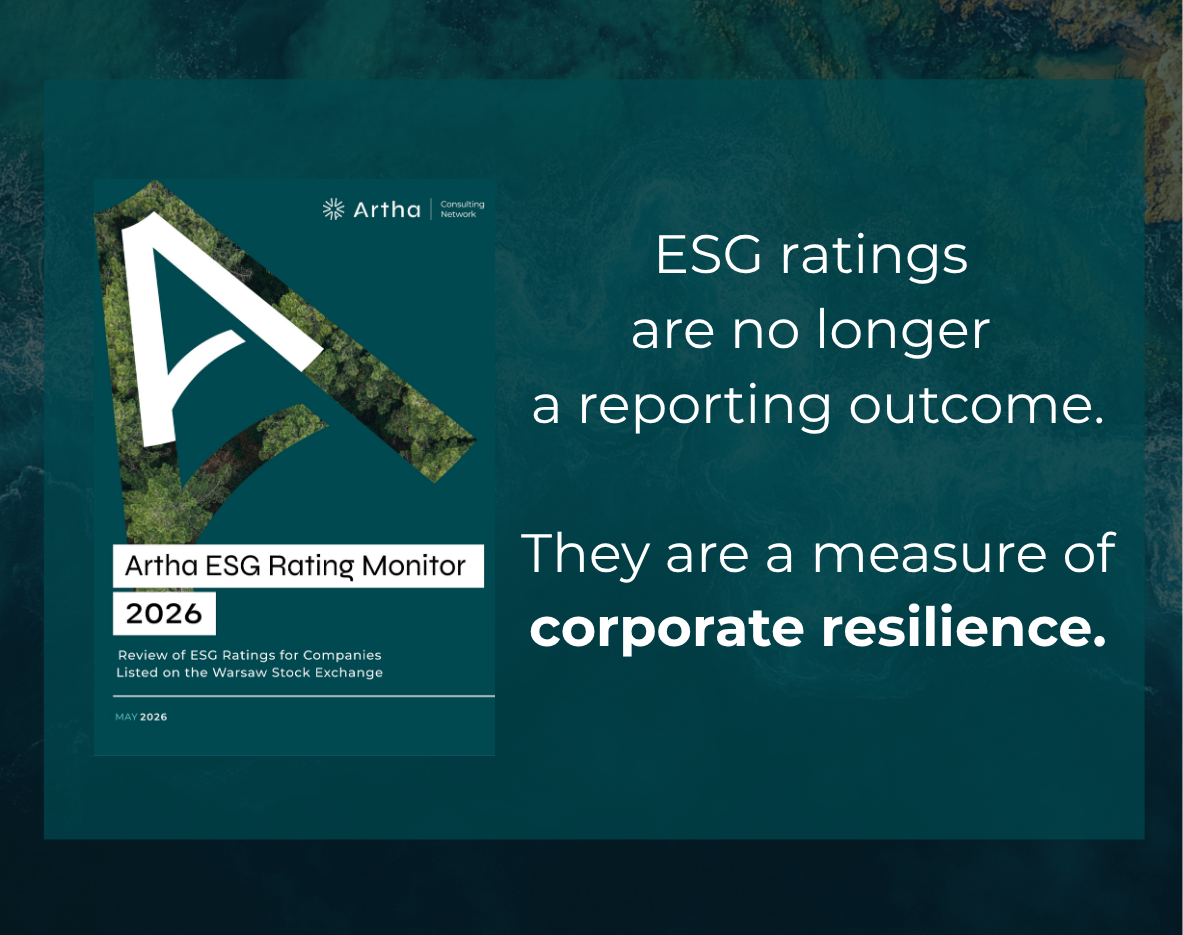
EXECUTIVE BRIEFING • FOR BOARDS AND SUPERVISORY BOARDS
ESG ratings on the supervisory board agenda
FROM EXTERNAL ASSESSMENT TO GOVERNANCE INSTRUMENT
For years, ESG ratings sat with sustainability and communication teams. That era is over. Today they sit on supervisory board agendas alongside credit risk, cyber risk and operational risk – because that is precisely what they are: condensed assessments of organisational resilience. This briefing outlines why oversight of ESG ratings should become a permanent governance topic, and which questions boards should be asking themselves now.
ESG ratings as a governance matter
The role of supervisory boards in overseeing sustainability has been systematically reinforced over the last few years – through European regulation (CSRD, CSDDD, EU Taxonomy) and through national corporate governance standards. In practice, oversight of ESG reporting quality, climate and social risk exposure, and alignment with market expectations is now an integral part of supervisory board duties – not an area to be delegated to a CSR team.
In that context, ESG ratings deliver something a supervisory board would not otherwise have: an external, independent and comparable view of how the company’s ESG management maturity stacks up against the market. This matters because management’s self-assessment is – by its nature – often too optimistic.
„ESG is a framework for managing risk, capital and business resilience. ESG ratings have become the reference point for assessing that maturity – replacing declarations with rigorous analysis and transparency.”
– Piotr Dmuchowski, CEO & CIO at PFR TFI S.A., Board Member at POLSIF
Three layers of supervisory board responsibility
Layer one: oversight of ESG strategy
The supervisory board needs a clear view of how the company’s ESG strategy connects to its business strategy, which KPIs are tracked by management, and how ratings inform that process. Key question: are ratings treated as a diagnostic signal, or only as an external communication tool?
Layer two: oversight of risk management
An ESG rating aggregates risks – environmental, social, regulatory and value-chain. The risk committee (or audit committee) should periodically analyse which low-scoring areas point to actual gaps in risk management, and which simply reflect insufficient disclosure. That distinction is essential for the right allocation of resources.
Layer three: oversight of data quality
ESG ratings increasingly rely on publicly available data – financial statements, sustainability reports, CSRD disclosures, CDP submissions. The quality, consistency and comparability of that data directly determine the resulting score. The audit committee should understand how the company’s ESG data collection and validation process is structured – with the same rigour applied to financial data.
„As the role of ESG ratings grows, so does the importance of data quality, methodological transparency and the trust placedin information reaching investors and other market participants.”
– Kamil Jesionowski, President of the National Council of Statutory Auditors, Polish Chamber of Statutory Auditors
What the market expects
Three stakeholder groups now dominate the way ESG ratings are applied to listed companies.
Institutional investors build portfolios and risk assessments using MSCI and Sustainalytics ESG ratings. They increasingly adopt a system-level investing approach, where individual company analysis takes account of the company’s impact on the entire portfolio and its links to systemic factors – climate change, demographics, geopolitics.
Banks and financing institutions – including the EBRD and commercial banks – base credit decisions, spreads and the structure of sustainability-linked instruments on ESG assessments. No rating or a low rating directly translates into a narrower set of available products or a higher cost of capital.
Business partners and corporate buyers – especially from Western markets – increasingly treat supplier’s ESG rating (most often EcoVadis) as part of their due-diligence procedures and contractual terms. As a result, ESG ratings are no longer relevant solely for public-market issuers.
„Independent ratings act as the infrastructure of trust. Through external, diverse methodologies, investors, counterpartiesand regulators receive a genuinely comparable view of management quality. Companies visible in rating systems gain an advantage – both in access to capital and in credibility.”
– Łukasz Olszewski, Head of Sales Central and Eastern Europe and Ukraine, S&P Global Ratings
Transparency as a baseline condition
Obtaining and maintaining a strong ESG rating is no longer possible without a systematic transparency policy. Every rating agency, depending on its methodology, expects data in a specific format and at a specific frequency. The signal a company sends through the way it reports speaks louder to investors than most investor relations communications.
For the supervisory board, this means treating the quality of ESG disclosures on a par with financial disclosures – with the same discipline, calendar and accountability.
How ratings shape competitive positioning
Companies visible in rating systems gain an advantage on three dimensions: access to capital (a broader pool of potential investors, lower cost of financing), credibility (a condensed, independent signal of management quality) and operational resilience (the rating as an early-warning tool for gaps). These outcomes cannot be achieved through communication alone – they require systematic work on processes, data and reporting.
Seven questions every board should be asking now
STRATEGIC CHECKLIST FOR BOARDS
- Which ESG ratings are most relevant for our company – given our investor base, counterparties and regulators?
- Do our competitors already hold ESG ratings, and what factors shape their performance?
- Does the quality and completeness of our ESG disclosures match that of our financial disclosures?
- Do we have a clear, up-to-date picture of our scores in the main systems (MSCI, S&P Global, Sustainalytics, EcoVadis, CDP)?
- Which gaps – in data, policies or reporting – drive our scores down most, and what is the plan to close them?
- Does the supervisory board receive a regular ESG rating report and trajectory, on par with financial information?
- Are ESG ratings part of executive incentive plans, alongside other strategic KPIs?
Recommendations and next steps
For supervisory boards and management boards of WSE-listed companies, we recommend three strategic steps.
First – a position diagnosis: for companies that already hold ESG ratings, this means a comprehensive assessment of current scores across all material rating systems, benchmarked against sector peers and international comparators. For companies that are not yet rated, the key priority is identifying which ESG ratings are most relevant from the perspective of investors, clients, and financial institutions, as well as assessing the organisation’s readiness for the rating process.
Second – a rating strategy: a deliberate selection of those ratings that are most critical for the company’s key stakeholder groups, together with a multi-year roadmap for improvement or implementation.
Third – institutional oversight: embedding ESG ratings as a recurring item on the supervisory board and audit committee calendars, with clear accountability assigned at management board level.
Artha Consulting Network supports WSE-listed companies both in improving existing ESG ratings and in preparing organisations for their first rating process – from benchmarking and gap assessments, through the design of ESG data management systems, to strategic advisory for management and supervisory boards on ESG governance.
Artha Consulting Network | ESG Rating Monitor 2026