

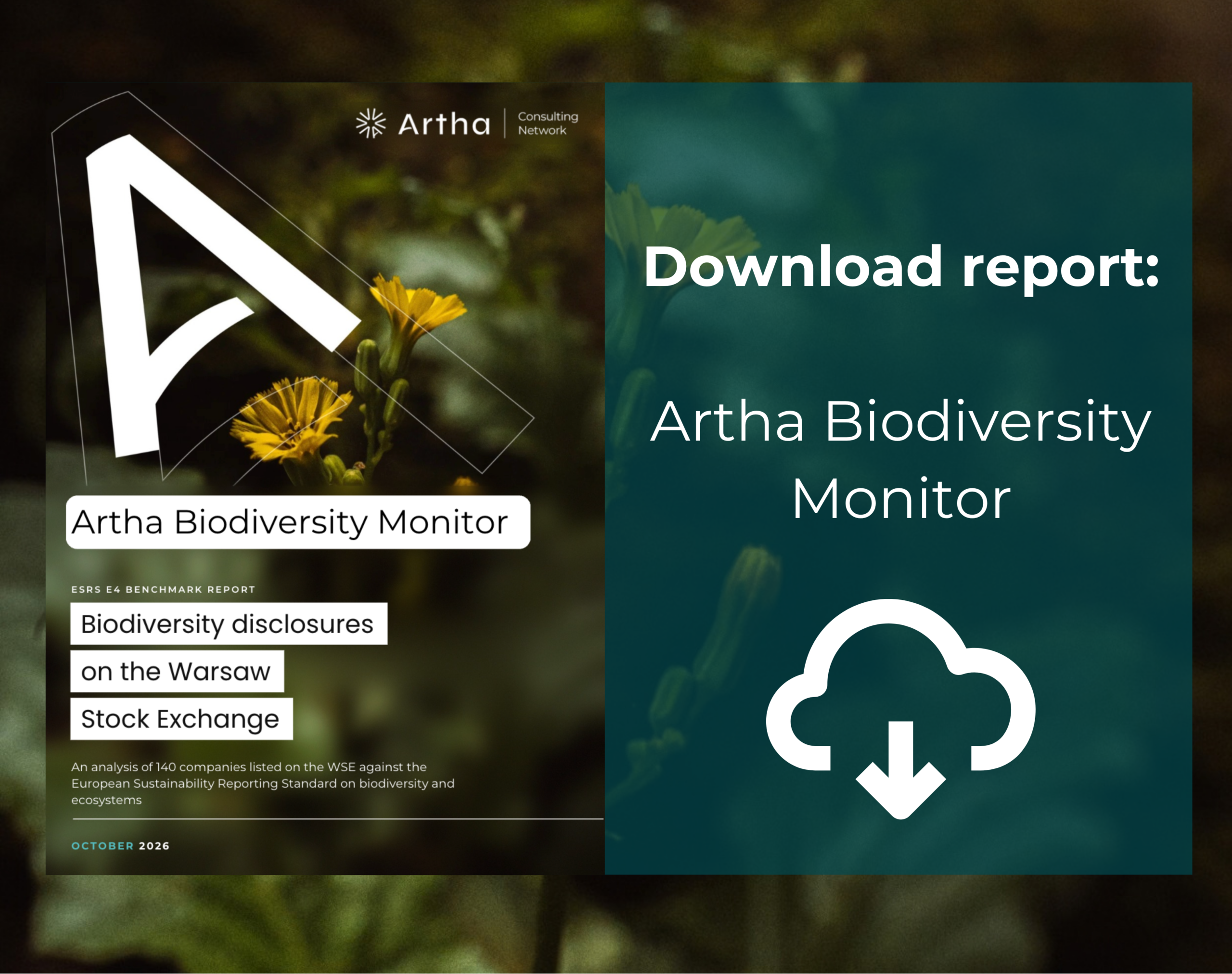
REPORT · ESRS E4 · WSE
Not one of the 26 Warsaw Stock Exchange-listed companies that identified biodiversity as a material topic has linked its targets to ecological thresholds.
This is one of the key findings of the Artha Biodiversity Monitor 2026, a benchmark of biodiversity and ecosystem disclosures (ESRS E4) among companies listed on the Warsaw Stock Exchange (WSE). The report was launched on 13 October 2026 during a webinar featuring its authors and experts from public administration, the financial sector and nature conservation institutions. The report and the webinar were held under the honorary patronage of the Rector of SGH Warsaw School of Economics.
REPORT PARTNERS
Polish Climate Congress · Chapter Zero Poland · National Foundation for Environmental Protection · Responsible Business Forum · UNEP/GRID-Warsaw Centre · Sustainable Investment Forum Poland
MEDIA PARTNERS
Newseria Biznes · Inwestycje Klimatyczne Magazine
What is the report about?
The Artha Biodiversity Monitor 2026 examines how companies in the WIG20, mWIG40 and sWIG80 indices report on their impacts and dependencies on nature. It compares 2025 reporting (65 companies whose reports were available at the time of analysis) with a full assessment of 140 companies for 2024. Each company that identified biodiversity as material was assessed against 17 ESRS E4 criteria, grouped into six areas: governance, impacts and dependencies, risks and opportunities, strategy and policies, targets, and actions and metrics.
The report addresses five questions that management and supervisory boards of listed companies face today:
■ The materiality gap. How many companies consider biodiversity a material topic, how this changed between 2024 and 2025, and why the widespread assessment of E4 as non-material raises questions about the robustness of double materiality assessments.
■ Market benchmark. How your company compares with its peers in terms of disclosure maturity, by index and by sector.
■ Sector analysis. Which industries take nature seriously, and in which the topic is virtually absent despite high exposure across the value chain. Of the 14 financial institutions assessed, only one identified biodiversity as material.
■ Disclosure gaps. Where companies perform best and where disclosures are almost entirely missing. Average disclosure maturity rose from 45% to 56%, yet targets linked to ecological thresholds, transition plans and the financial effects of nature-related risks remain largely absent.
■ Regulatory context. What the Omnibus package, the “stop-the-clock” directive and the “quick fix” regulation, which allowed some E4 disclosures to be deferred, mean for biodiversity reporting, and why these exemptions are only temporary.
Who is it for? The report is intended for management and supervisory boards of listed companies, heads of ESG, reporting and risk management, as well as financial institutions and investors active on the WSE.
Webinar summary
The report launch was accompanied by a webinar during which the authors presented the research findings and invited experts commented on them from the perspectives of public administration, the financial sector and nature conservation. The discussion covered a range of topics, centring on three main themes:
1. Biodiversity in WSE-listed company reports. The authors showed how reporting evolved between 2024 and 2025, which sectors recognise nature as a material topic, and what this means for boards and investors.
2. Regulation and public policy. The experts discussed how EU and national nature-related regulations, including ecosystem restoration, are shaping expectations of business.
3. The role of the financial sector. We discussed how banks, investors and rating agencies are beginning to factor nature-related risks into financing decisions and company assessments.
The full webinar recording is available on our YouTube channel. [LINK]
Speakers
Irena Pichola
CEO, Artha Consulting Network · Moderator
One of the most experienced ESG experts in Poland and Central Europe, with over 25 years of experience in strategic advisory for leading corporations and public institutions. For nearly a decade she was a Partner at Deloitte, where she led the Sustainability Consulting practice covering 17 countries and more than 140 experts. She is President of the Management Board of the Responsible Business Forum and Chair of the Steering Committee of Chapter Zero Poland.
Aleksander Czarski
Senior ESG Consultant, Artha Consulting Network · Report author
Presented the report findings.
The invited experts included:
■ Maria Andrzejewska – Vice-President of the National Foundation for Environmental Protection; for many years Director General of the UNEP/GRID-Warsaw Centre, UNEP expert on environmental data and co-author of the GEO-6 report
■ Dr Piotr Mikołajczyk – Chief Specialist for Biology and Environmental Protection, UNEP/GRID-Warsaw Centre
■ Marta Höffner – Counsellor, Ecosystem Restoration Unit, Department of Strategy and Climate Resilience, Ministry of Climate and Environment
■ Michał Siwek – Head of Decarbonization & Biodiversity Product, BNP Paribas Bank Polska
■ Alexandre Nakhle – Senior ESG Client Engagement Specialist, S&P Global Sustainable1
■ Benjamin Matthews – Earth Blox
Do you know how your company depends on nature?
With most of the WSE-listed companies assessed considering biodiversity non-material, and those that do report on it still unable to determine its financial effects, the question of dependence on nature is becoming increasingly practical. Disclosure exemptions are temporary.
The Artha Biodiversity Monitor 2026 provides a reference point for starting this conversation at management and supervisory board level.
Webinar Materials
Download the Artha Biodiversity Monitor report
Information Clause (GDPR – Art. 13)
The controller of your personal data is Artha Consulting Sp. z o.o., with its registered office at ul. Konwaliowa 19C, 05-552 Łazy, Poland. Personal data are processed for the purposes of event registration and participation (Art. 6(1)(b) GDPR), compliance with legal obligations (Art. 6(1)(c) GDPR), the pursuit of organisational purposes (Art. 6(1)(f) GDPR) and, where consent has been given, electronic marketing (Art. 6(1)(a) GDPR and Art. 398 of the Polish Electronic Communications Law).
Please note that the event will be recorded by the media (photographs, video recordings and live streaming).
Data subjects have the right to access, rectify and erase their data, restrict or object to its processing, request data portability and withdraw consent at any time, as well as the right to lodge a complaint with the President of the Personal Data Protection Office (UODO).