

What is the report about?
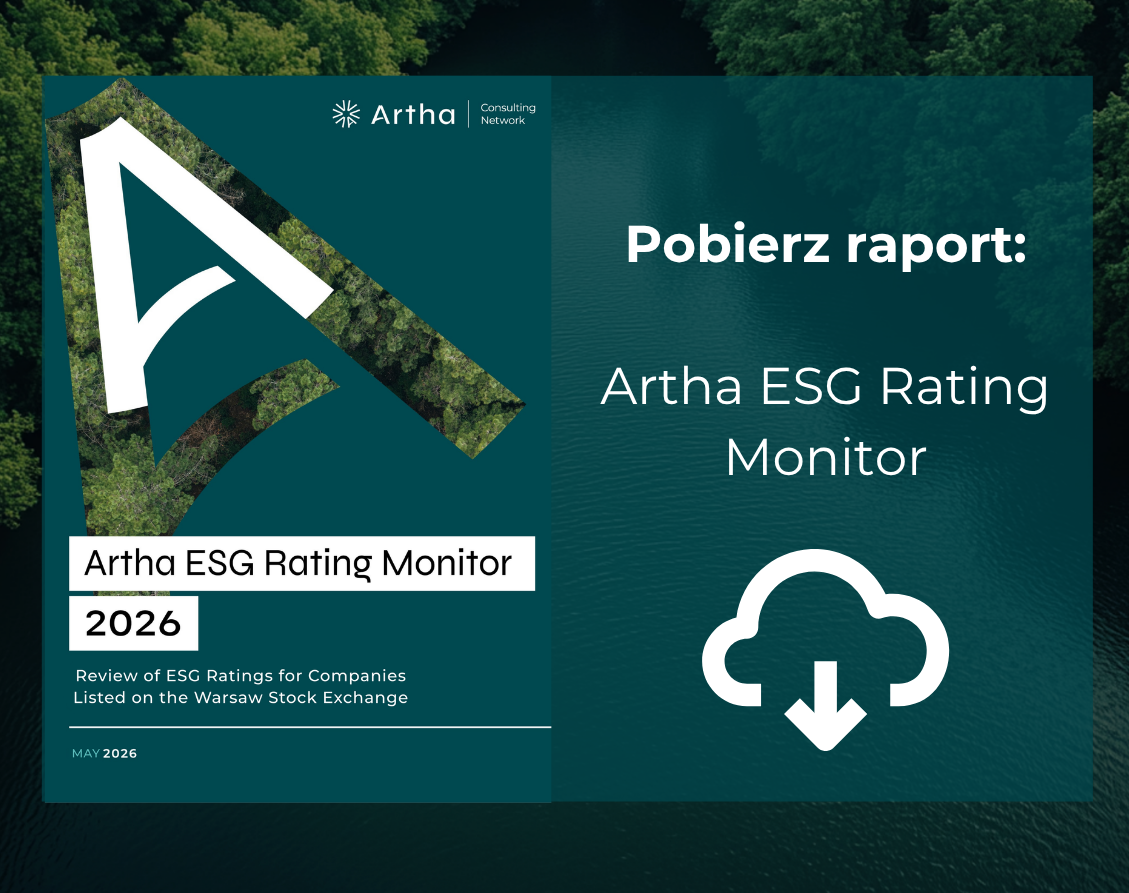
Artha ESG Rating Monitor 2026 brings together the ESG ratings of 140 companies in the WIG20, mWIG40 and sWIG80 indices, issued by five leading agencies: S&P Global, MSCI, CDP, EcoVadis and Sustainalytics[cite: 2]. It is the first map of its kind of the Polish ESG market[cite: 2]. The report answers five key questions facing the management and supervisory boards of listed companies today[cite: 2]:- Market benchmark. Where your company stands relative to its peers – by index, sector and number of ratings held[cite: 2].
- A complete picture of WSE rating coverage. How many companies have ratings and how many do not – and what this gap means for investors and management boards[cite: 2].
- Agency selection matrix. Not every rating is right for every company[cite: 2]. The report includes a practical guide to which rating to choose depending on profile, sector and stakeholder group (investors, supply chain, regulators)[cite: 2].
- Analysis of divergence between agencies. One company, five different scores[cite: 2]. The report explains how these divergences arise and identifies the sectors in which they are greatest[cite: 2].
- Regulatory context. EU Regulation 2024/3005 on ESG rating activities comes into force in July 2026, and the Omnibus package changes the scope of the CSRD[cite: 2]. The report explains what this means for companies today and over the next two to three years[cite: 2].
Webinar summary
The launch of the report was accompanied by an open webinar, during which the authors presented the study’s findings and answered participants’ questions live[cite: 2]. The discussion centred on four themes[cite: 2].- The WSE ratings map. The authors showed what the rating coverage of the 140 companies in the WIG20, mWIG40 and sWIG80 really looks like – and what the fact that such a large part of the market remains outside the rating system means for investors and management boards[cite: 2].
- New regulation of rating agencies. The experts discussed EU Regulation 2024/3005: what exactly it changes, whom it covers and when it will begin to have a real impact on the operations of agencies and the companies they rate[cite: 2].
- How to choose a rating agency. The practical part of the meeting was devoted to which rating works for which company profile, and why – taking into account the expectations of different stakeholder groups[cite: 2].
- Q&A with the authors and experts. Participants could put questions to the report’s authors and invited guests in real time, which made it possible to test the study’s findings against the perspective of the market and regulators[cite: 2].
Speakers
The meeting was hosted by Irena Pichola, CEO of Artha Consulting Network – one of the most experienced ESG experts in Poland and Central Europe, with more than 25 years of experience in strategic advisory for the largest corporations and public institutions[cite: 2]. For almost a decade she was a Partner at Deloitte, where she led the Sustainability Consulting practice covering 17 countries and more than 140 experts[cite: 2]. She is President of the Management Board of the Responsible Business Forum and Chair of the Steering Committee of Chapter Zero Poland[cite: 2]. The report’s findings were presented by its authors[cite: 2]: Maciej Orczyk, ESG Manager at Artha Consulting Network – an ESG expert with more than eight years of experience at the intersection of finance and sustainability, specialising in supporting companies in selecting rating agencies and preparing for their assessments; he has led rating projects for WIG20 companies[cite: 2]. Alicja Reindl, Consultant at Artha Consulting Network – an ESG specialist with experience in ESRS reporting, the EU Taxonomy and carbon footprint analysis, and a member of the project team that prepared a WIG20 company for its MSCI rating assessment[cite: 2]. The invited experts included[cite: 2]:- Robert Adamczyk – ESG Adviser at EBRD, Member of the Management Board of the Responsible Business Forum[cite: 2]
- Marek Szolc – Ethics & Sustainable Procurement Methodology Lead at EcoVadis[cite: 2]
- Łukasz Olszewski – Head of Sales Central and Eastern Europe and Ukraine at S&P Global Ratings[cite: 2]
- Piotr Dmuchowski – CEO & CIO at PFR TFI S.A., Member of the Management Board of POLSIF[cite: 2]
- Katarzyna Szwarc – Vice President, Government Affairs at MSCI Inc.[cite: 2]
Do you know how the market sees your company?
With 41% of companies in WSE indices holding no ESG rating at all, the question of how the market assesses your organisation is becoming increasingly practical[cite: 2]. The Artha ESG Rating Monitor 2026 report provides a point of reference from which to begin this conversation within the management board and the supervisory board[cite: 2].Materiały z Webinaru
Zapraszamy do pobrania prezentacji oraz raportu Artha ESG Monitor 2026
Klauzula informacyjna (RODO – art. 13)
Administratorem danych osobowych jest Artha Consulting Sp. z o.o., z siedzibą pod adresem: ul. Konwaliowa 19C, 05-552 Łazy. Dane są przetwarzane w celu rejestracji i uczestnictwa w wydarzeniu (art. 6 ust. 1 lit. b RODO), wypełnienia obowiązków prawnych (art. 6 ust. 1 lit. c RODO), realizacji celów organizacyjnych (art. 6 ust. 1 lit. f RODO), a w przypadku wyrażenia zgody – także w celach marketingu elektronicznego (art. 6 ust. 1 lit. a RODO oraz art. 398 PKE).
Informujemy, że wydarzenie będzie rejestrowane przez media (zdjęcia, nagrania wideo, transmisja na żywo).
Osobom, których dane dotyczą, przysługuje prawo dostępu do danych, ich sprostowania, usunięcia, ograniczenia przetwarzania, przenoszenia, wniesienia sprzeciwu, wycofania zgody, a także prawo do wniesienia skargi do Prezesa Urzędu Ochrony Danych Osobowych (UODO).