

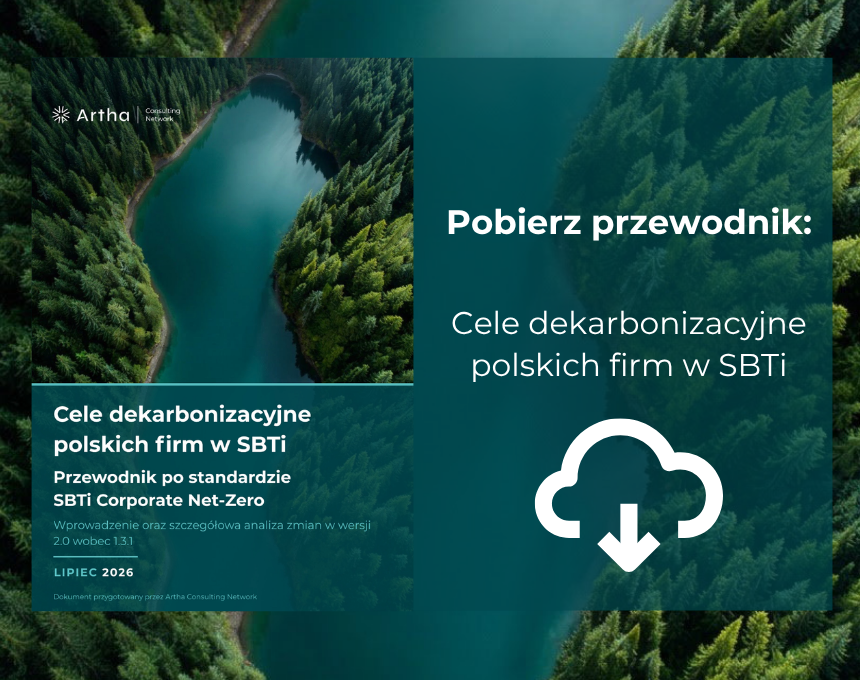
Only 12% of Polish companies registered with the SBTi have a full net-zero commitment – half the global average (25%). This is one of the findings of Artha’s guide “Decarbonisation Targets of Polish Companies in the SBTi: A Guide to the SBTi Corporate Net-Zero Standard” – a publication that brings together the essential knowledge on version 2.0 of the SBTi standard and presents an up-to-date diagnosis of the Polish market. The guide was launched during a webinar on 23 July 2026.
What is the guide about?
The guide compiles data on 69 Polish companies registered in the SBTi database, set against 15,175 companies globally, and discusses in detail the Corporate Net-Zero Standard in its new version 2.0, published in June 2026. It is the first diagnosis of its kind of the Polish SBTi market.
The guide answers five key questions facing the management boards and ESG teams of Polish companies today:
• Diagnosis of the Polish market. How many Polish companies have approved SBTi targets, how fast that number is growing, which sectors are under-represented – and how Poland compares with Europe and the rest of the world.
• A paradigm shift in version 2.0. The standard is moving from a one-off validation of ambition to a model of continuous implementation. What this means in practice for companies that already have approved targets, and for those still planning validation.
• Category A or B – which does your company belong to? The new version of the standard introduces two formal categories based on size and geography. The guide includes the full threshold matrix and explains which requirements apply in each.
• Timeline and checklist. What needs to be prepared before 1 February 2027 – from the emissions inventory and choice of methodology to the transition plan and stakeholder communication.
• A new approach to emission scopes. Separate targets for Scopes 1, 2 and 3, a new asset transition method, an implementation hierarchy, hourly matching in Scope 2 and a 5% materiality threshold in Scope 3 – all compared with version 1.3.1.
The guide is intended for management and supervisory boards, ESG and strategy directors, CFOs, sustainability teams, and specialists responsible for climate reporting and relations with financial institutions.
Webinar summary – 23 July 2026
The launch of the guide was accompanied by an open webinar, during which the authors presented the key findings and invited experts discussed SBTi implementation from the perspective of three sectors. The discussion centred on four themes.
• The Polish SBTi market in numbers. The authors showed the pace of growth – from 1 company in 2020 to 69 in 2026 – as well as the qualitative gaps: a sectoral gap (no companies from mining, steel, cement or gas) and an ambition gap (only 12% of companies have a full net-zero target).
• Climate targets and access to finance. Kamil Radziwon (Erste Group) discussed how formally validated climate targets increasingly determine loan terms and the structure of financing. The conversation also covered banks’ expectations of corporate clients in the context of the CSRD and the EU Taxonomy.
• What version 2.0 changes. Artha’s experts took participants through the most important changes: the new categories A and B, the rolling base year, the mandatory transition plan, the implementation hierarchy and the redesigned Scope 2. Specific recommendations for the transition period were also shared.
• Sector perspective: retail, real estate, banking. Anna Gorączka (Allegro) spoke about the role of emissions reduction in supply chains from the perspective of a large e-commerce platform. Aleksandra Noworyta (EPP) presented the challenges facing the real estate sector – from BREEAM to LCA. The session closed with a Q&A with participants.
The full recording of the webinar is available on our YouTube channel.
Is your company ready for SBTi 2.0?
The new version of the standard takes effect on 1 February 2027. Companies that already have approved targets need to assess what the change means for them. Companies still planning validation will be starting out in a new reality. The guide provides a point of reference from which to begin this conversation within the management board and the ESG team.
Materiały z Webinaru
Zapraszamy do pobrania przewodnika
Cele dekarbonizacyjne polskich firm w SBTi
Klauzula informacyjna (RODO – art. 13)
Administratorem danych osobowych jest Artha Consulting Sp. z o.o., z siedzibą pod adresem: ul. Konwaliowa 19C, 05-552 Łazy. Dane są przetwarzane w celu rejestracji i uczestnictwa w wydarzeniu (art. 6 ust. 1 lit. b RODO), wypełnienia obowiązków prawnych (art. 6 ust. 1 lit. c RODO), realizacji celów organizacyjnych (art. 6 ust. 1 lit. f RODO), a w przypadku wyrażenia zgody – także w celach marketingu elektronicznego (art. 6 ust. 1 lit. a RODO oraz art. 398 PKE).
Informujemy, że wydarzenie będzie rejestrowane przez media (zdjęcia, nagrania wideo, transmisja na żywo).
Osobom, których dane dotyczą, przysługuje prawo dostępu do danych, ich sprostowania, usunięcia, ograniczenia przetwarzania, przenoszenia, wniesienia sprzeciwu, wycofania zgody, a także prawo do wniesienia skargi do Prezesa Urzędu Ochrony Danych Osobowych (UODO).